
Back to Pentecost – A day about New Evangelization and the Baptism in the Holy Spirit in the Catholic Cathedral, Stockholm

The Holy Spirit and evangelization are two sides of the same coin, said F. Krzysztof Czerwionka CR who led the teaching this Saturday afternoon, June 13, in the Catholic Cathedral in Stockholm. Spreading the gospel cannot be done effectively without the power of the Holy Spirit, and if you have received the Holy Spirit, then you also feel a strong urge to share the gospel.
CHARIS Nordic was the organizer of the conference. "Praying for the gift of the Holy Spirit and learning how to be more effective in realizing our calling to bear witness to the gospel is the theme of this day," said coordinator Bengt Malmgren in his welcome message.
F. Krzysztof is the founder and leader of the Charismatic Community [the Risen Christ "GALILEA"] and the director of St. Marcus School of New Evangelization in Stryszawa, which cooperates with other evangelization schools in Poland and internationally.
F. Krzysztof underwent a personal conversion in 1977. After his ordination, he lived lived according to the charism of his congregation and saw the signs of the times in Pope John Paul II's call to new evangelization.
During the afternoon, teaching was interspersed with prayer and praise and ended with sacramental blessing and prayer for the outpouring of the Holy Spirit and equipping with the gifts of the Spirit to go out in the new evangelization.
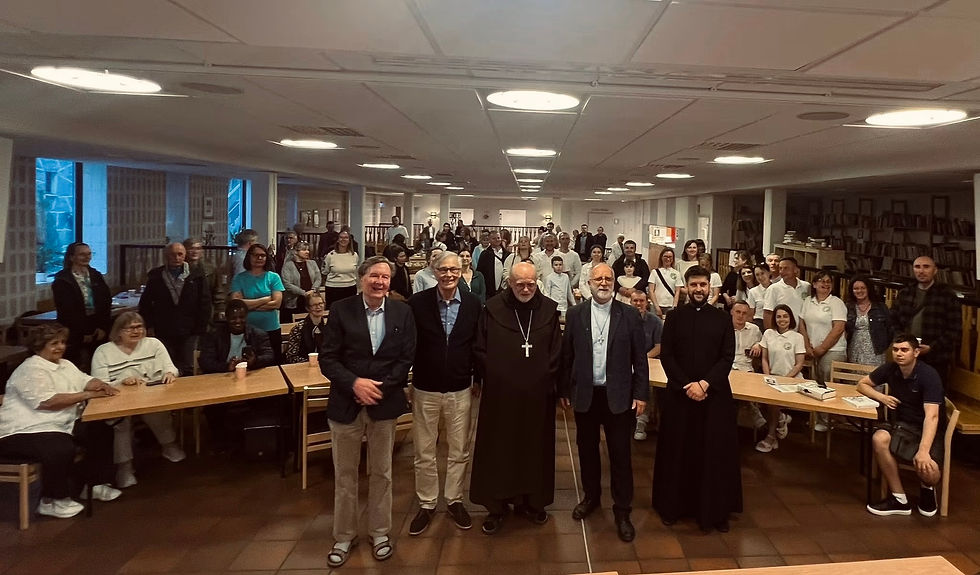
Photo: Anastazja Lozowska
The Challenge of Evangelism
The aim of the teaching was to give the evangelizers (= all of us) tools so that we do not lose courage in the face of the fundamental challenges, because evangelism has always been and remains a constant challenge for Jesus' disciples in every time and in every place, f Krzysztof emphasized.
He reviewed what the Church's Magisterium has said about evangelism since the Second Vatican Council:
1. St. Paul VI: The Church exists for evangelization (Evangelii nuntiandi).
2. St. John Paul II: New evangelization with new methods, new expression and new zeal.
3. Benedict XVI: The Promotion of the New Evangelization.
4. Francis: To be in a permanent state of mission. (Evangelii gaudium], curiareform, synodality.
5. Leo XIV: Every Christian is called to be a missionary wherever he or she is.
Obstacles to evangelization can be:
1. Loss of the first love for Jesus.
2. Fear of rejection.
3. The belief that the testimony of life alone is enough.
4. Convenience and indifference.
5. Lack of personal holiness.
6. Neglect of prayer and the work of the Holy Spirit.
The apostles bore with great power witness to the resurrection of Jesus. The first motivation for evangelism is the love of Jesus that we ourselves have received.
In order to evangelize, one needs to have gone through four basic processes:
1. JORDAN (baptism of Jesus). To experience God's personal and unconditional love. "You are my beloved Son, in you I have my joy." Without Jordan, there is no strength for the mission. Only those who are convinced can convince others.
2. DAMASCUS (Paul's conversion). To personally meet the risen Jesus. Like Paul on the road to Damascus, every evangelizer needs a personal encounter with Christ.
3. EMMAUS (The disciples meet the Risen One). To let the heart burn with God's Word. The disciples at Emmaus had their hearts lit by the Scriptures and returned to testify. Only those who are on fire themselves can ignite others.
4. UPPER ROOM (Pentecost – The Spirit fell on everyone). To receive the power of the Holy Spirit for mission. Pentecost and evangelism cannot be separated.
We need: dynamis – power for ministry and parrhesia – courage to proclaim the gospel.
CONCLUSION: The New Evangelization is about allowing God's Word to spread. Evangelism with power does not mean that the evangelizer runs, but that God's Word is allowed to run on and bear fruit.
Panel discussion with Bishop Anders
After the mass at 17.00, which was celebrated together with the parish, everyone was invited to a church coffee out of the ordinary that our Ukrainian friends were responsible for. Then there was a panel discussion on Evangelization and the Holy Spirit with F. Krzysztof and Cardinal Bishop Anders Arborelius who joined in the evening. Ulf Ekman was the moderator.

As interpreters, Polish to Swedish and vice versa, Krystian Zacheia and Justyna Kadziewicz participated. The afternoon's lectures were interpreted by Katarzyna Trock.
Bishop Anders said that the basic state of the Church is to evangelize, and she must constantly start anew. The gospel is not something we own, but something we have to receive and then pass on.
When asked where we see the new evangelization today, Bishop Anders mentioned martyrdom. When the church is persecuted and people have to sacrifice something for their faith, then she is strengthened. As examples, he mentioned the old Soviet Union, Poland during the communist era, but also today's Iran and China, where under the surface there is an evangelization that is not noticeable, but which is tangible.In Sweden, the Catholic Church has grown through immigration that has come in different waves, but the church has not always been so good at taking care of those who come, we have to be humble and acknowledge that, Bishop Anders said. Some have been missed, such as the large wave of Hispanics in the 1970s and 80s, where many went to the neo-pentecostal churches. In Älvsjö Fair in Stockholm a charismatic service is held every week with 1000s of Spanish speaking people. “So the Holy Spirit can also work outside the boundaries of the Catholic Church," the bishop said.
Ulf Ekman noted that it is increasingly common to see that people with no previous Christian experience come in directly from the street and feel that they have to become Catholics. Father Krzyzstof said that you see it in Poland in the larger cities as well, but the big tendency is otherwise for people to leave the church in large waves. Therefore, there is a need to deepen faith in order to motivate people to stay. That is why the Bishops' Conference in Poland has introduced an adult catechism, a catechumenate for those who have already been baptized. The Commission for Catechism and New Evangelization wants to convey not only an intellectual doctrine of faith, but a living experience of the living God.F. Krzysztof described how to present the gospel to seekers in Galilea: Personal testimony is fundamental. Then it is about taking care of the people and inviting them to small groups and a spiritual companionship where they can grow in living their faith in everyday life, something that is often lacking in the ordinary parishes.
The school of evangelization offers ambitious courses in the methodology of evangelism and maturing in one's Christian faith. Everything depends on getting to know the Holy Spirit who is the one who is present in our lives, helps and comforts, makes you experience that Jesus loves you and is with you. The Holy Spirit is the one who makes faith alive, makes prayer, the word, tradition, communion and life alive. This and much more was discussed this evening.

At the end, a question from the audience came up: Can Catholics make contact with unknown people in the street and talk about matters of faith, or is it only Protestants who do?
Bishop Anders replied that if the Holy Spirit prompts you to do so, you must do it. F. Krzysztof said that their evangelism courses include street evangelism as a practical element. Ulf Ekman, who has written a book on evangelism through friendship (see below), said that in Sweden it is probably not the most effective method to go after people directly, especially since Swedes are quite reserved. "Food needs to be warmed up before it is served," therefore personal friendship is the best method to share the gospel with new people. This does not mean that street evangelism has no place, the problem today is hardly that Catholics are too bold in their witness, rather the opposite.
Note. Ulf Ekman's book: Vänner emellan – Att dela tron i en modern tid, Catholica. Father Damian Eze, born in Nigeria and vicar in Luleå, has campaigns every summer with street evangelism in different places in north of Sweden. F. Damian is a priest whose faith and zeal for the mission are reminiscent of St. Paul. In a recently published book, CREDO ERGO SUM, he is interviewed about his thoughts on Christian faith and modern society by a researcher from the Centre for Multidisciplinary Research on Religion and Society (CRS) at Uppsala University.
Comments